
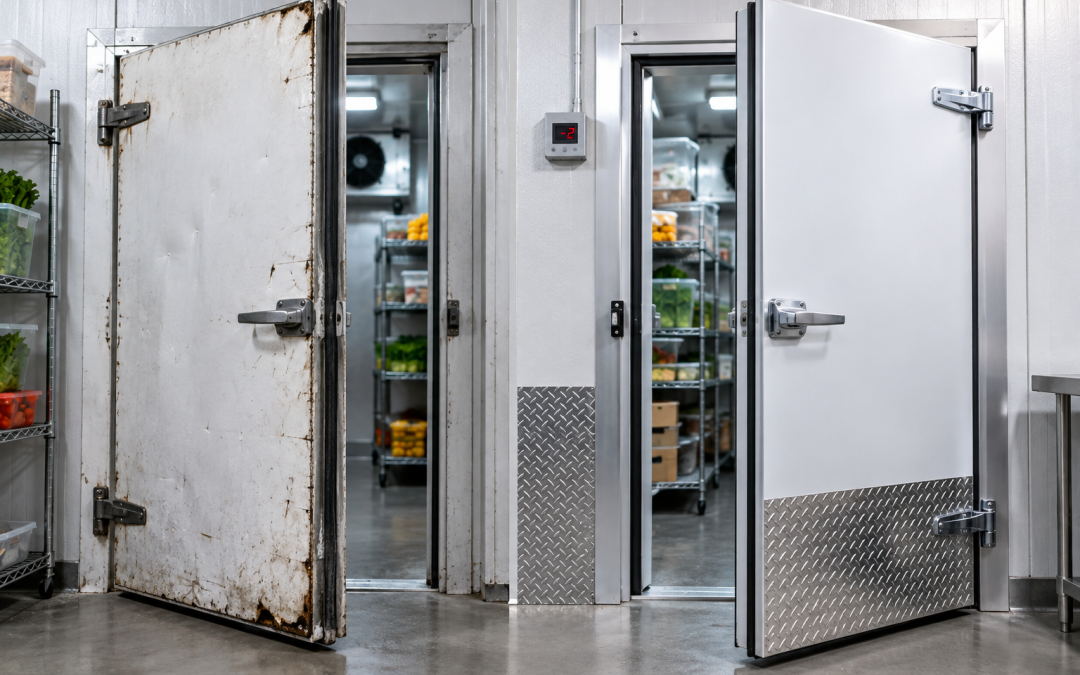
Deciding between a repair and a full walk-in cooler door replacement comes down to whether the door panel itself is still structurally sound. Worn gaskets, loose hinges, and minor cosmetic damage are usually repairable. But warped or cracked panels, chronic air leaks, and a door that won’t seal even with a brand-new gasket mean it’s time to replace the door instead of patching it again.
Repair or Replace? What the Damage Tells You
Not every problem with a walk-in cooler door means you need a whole new door. Most issues start small: a torn gasket, a sagging hinge, a latch that won’t catch. Those are repair jobs, not replacement jobs, and fixing them quickly is usually the cheaper and faster path for a restaurant, grocery store, or medical facility that can’t afford downtime.
The trouble starts when the same door keeps coming back with the same complaint, or when a fix that used to work stops holding. That pattern is the clearest sign the door panel itself, not just its parts, has failed, and it’s worth stepping back and looking at the whole door rather than replacing the same part a second or third time.
When Repair Is Usually Enough
- The gasket is torn, brittle, or no longer forms a seal, but the door panel itself is straight and solid
- A hinge, latch, or door closer is loose, broken, or misaligned
- There’s cosmetic damage — scuffs, dents, or surface rust — with no warping or structural compromise
- Occasional condensation or light frost that traces back to a door sweep, threshold, or ambient humidity rather than the door panel
If your gasket is the only culprit, our gasket repair and replacement service can usually restore a proper seal in a single visit, often for a fraction of the cost of a new door. It’s also worth reading through our guide on the signs your walk-in cooler gasket needs replacing if you’re not yet sure whether the gasket or the door itself is the real problem.
When Full Replacement Makes More Sense
- Air leaks persist around the frame even after a fresh gasket has been installed
- Condensation or ice buildup on or around the door keeps returning no matter what’s been repaired
- The door or frame shows visible warping, cracking, or delamination
- The door is difficult or unsafe to operate because it sags, drags, or no longer sits flush in its frame
- The same door has needed repeat repairs, and the cost of those repairs keeps adding up
A damaged door doesn’t just let cold air escape — it forces the compressor to run harder to compensate, which drives up energy costs and puts extra wear on the whole refrigeration system. Once a door reaches that point, another round of repairs is usually a short-term patch rather than a real fix.
Repair vs. Replace at a Glance
| Situation | Likely Fix |
|---|---|
| Torn or worn gasket, straight door | Gasket replacement |
| Loose hinge, latch, or closer | Hardware repair |
| Warped, cracked, or delaminated panel | Door replacement |
| Door won’t seal despite new gasket | Door replacement |
| Repeat repairs on the same door | Door replacement |
What’s Included When You Replace the Door
Before fabrication, a technician measures the exact door opening, frame depth, and hinge placement on-site, so the new door fits the way the original was supposed to. Every replacement door is built with an insulated steel or fiberglass-faced panel core designed for temperature consistency and impact resistance from daily cart traffic, and it ships with upgraded hinges, latches, and a door closer already installed.
For kitchens and coolers where carts, pallet jacks, or foot traffic take a toll on the lower panel and corners, diamond plate reinforcement can be added to the kick plate for extra protection. If parts like hinges, latches, or thresholds need attention on their own, our walk-in cooler parts and accessories page covers what’s available separately from a full door swap.
Installation is scheduled around your business hours so a restaurant, grocery store, or medical facility isn’t left without a working cooler during service.
Health Code and Energy Costs Add Up Behind the Scenes
A cooler door that won’t seal isn’t just an efficiency problem. Restaurants, grocery stores, and medical facilities are all held to health code temperature requirements, and a door that lets warm air in makes it harder to keep a walk-in cooler or freezer at a stable, compliant temperature. Technicians familiar with those requirements can flag when a door is putting your inspection at risk, not just your energy bill.
The compressor strain caused by a bad seal also tends to shorten the life of other refrigeration components, since the system is working harder than it was designed to just to hold temperature. Replacing a door before it reaches that point protects the rest of the unit, not just the door itself.
Next Steps
If your walk-in cooler door has gone past what a new gasket or hardware fix can solve, a free on-site estimate is the fastest way to know for sure. A technician can look at the actual door and frame, tell you honestly whether repair or replacement makes sense, and walk you through what a new door would include. Contact Gasket Doctor to schedule a visit anywhere from Aventura to Homestead, Coral Springs to Hollywood, or Boca Raton to Jupiter — we’re available 24/7.
Frequently Asked Questions
If a new gasket doesn’t stop air leaks, or the door still won’t sit flush in its frame after hardware repairs, the door panel itself is likely the underlying problem rather than any single part. Visible warping, cracking, or delamination on the panel or frame are also clear signs that another repair won’t hold for long. Repeated gasket failures on the same door within a short period usually point the same direction, since a good gasket can’t compensate for a warped panel.
Yes. A technician measures your existing door opening, frame depth, and hinge placement on-site and fabricates a replacement door to fit that exact space, so the rest of the walk-in cooler or freezer stays exactly as it is. Installation is scheduled around your business hours so a restaurant, grocery store, or medical facility isn’t left without a working cooler mid-shift. In most cases, only the door and its hardware are involved.
A new door includes an insulated steel or fiberglass-faced panel core built for temperature consistency and impact resistance, along with upgraded hinges, latches, and a door closer. Optional diamond plate reinforcement can also be added to the kick plate and corners for units that see heavy cart, pallet jack, or foot traffic. Everything is sized and fabricated to your specific door opening rather than sold as an off-the-shelf fit.
Replacement doors are custom-built to the measurements of your specific opening rather than ordered as a fixed, pre-made size, so the age or original brand of the walk-in unit generally isn’t a barrier. A technician confirms fit by measuring the door opening, frame depth, and hinge placement on-site before fabrication begins. This approach works whether the original unit is a recent installation or has been in service for years.
When a door needs repeat repairs for the same underlying issue, those individual costs add up while the root problem stays unresolved and the door keeps failing. A door that won’t seal properly also forces the compressor to run harder to hold temperature, which raises energy costs for as long as the door goes unreplaced. In cases like that, one properly fitted replacement door is typically more cost-effective over time than an ongoing series of repair visits.