
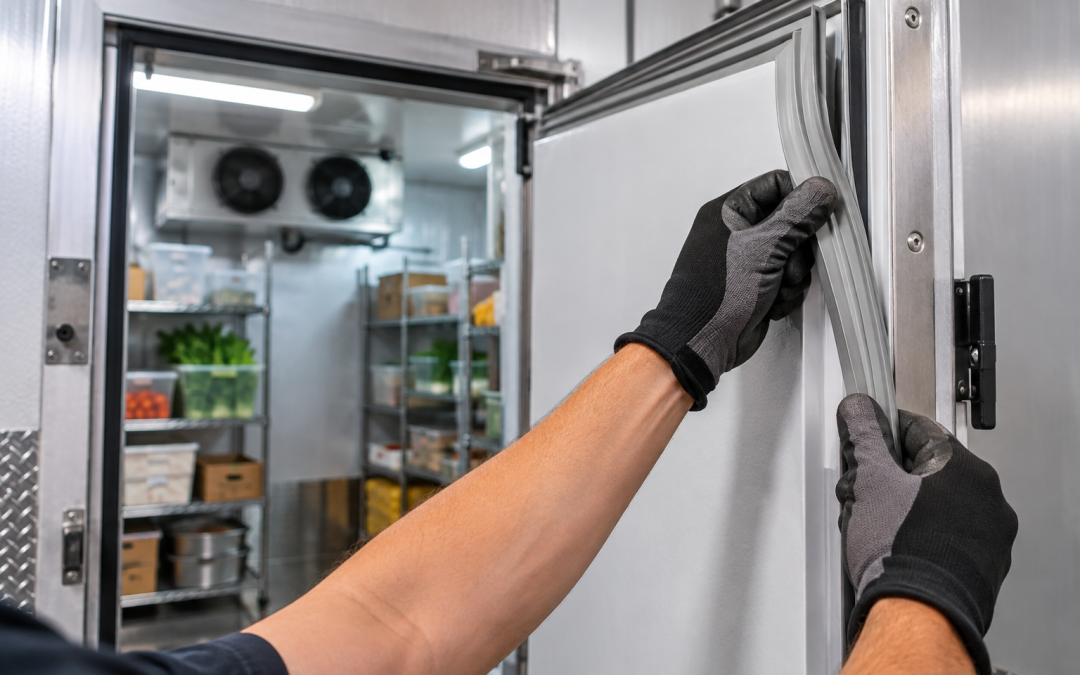
A walk-in cooler gasket typically needs replacing when it cracks, hardens, pulls away from the door frame, or fails the simple paper test, letting cold air escape and forcing the compressor to run harder. In South Florida’s heat and humidity, these signs appear faster than manufacturers expect. Left unaddressed, a failing seal drives up energy costs and stresses the whole unit. Gasket repair and replacement restores a tight seal, usually in a single visit.
Why Gasket Condition Matters More Than It Seems
The gasket running around your walk-in cooler or reach-in door is the only thing standing between the temperature you’re paying to maintain and the warm kitchen or stockroom air outside it. Once that seal degrades, the refrigeration system compensates by running longer and harder, which shows up as higher utility bills and, eventually, as a compressor under more strain than it should be.
South Florida operators see gasket failure earlier than businesses in milder climates. Constant temperature swings between a cold walk-in and a hot back-of-house, combined with humidity and doors that open dozens of times a shift, break down gasket material faster year-round. Recognizing the warning signs early can prevent a minor repair from becoming a bigger problem.
The Paper Test: A Quick Way to Check
Before listing the visible signs, it helps to know the simplest diagnostic available to any operator. Close the cooler door on a strip of paper so it’s pinched between the gasket and the frame, then pull the paper out. If it slides free with little resistance, the seal isn’t holding, even if the gasket looks fine at a glance. Run this test at a few points around the door, since a gasket can seal tightly in one spot and fail in another.
Visible and Physical Warning Signs
Most gasket failures announce themselves before they cause serious energy loss. Watch for:
- Cracking, splitting, or tearing along the gasket’s surface or folds
- Hardening or brittleness, where the material no longer flexes back into shape after the door closes
- Flattening, where the gasket has been compressed so many times it no longer springs back to fill the gap
- Pulling away from the frame or sagging in sections instead of sitting flush
- Mold or mildew buildup, often from trapped moisture in a cracked or loosely sealed gasket
- Repeated patch jobs, where tape or sealant has been applied more than once to the same section
Signs You’ll Notice Without Touching the Door
Some indicators show up in how the unit performs rather than how the gasket looks:
- Cold air noticeably escaping around the door edges when the unit is running
- Condensation forming on or around the door frame
- Ice or frost buildup near the seal or on nearby shelving
- Temperature fluctuations inside the unit, even with the thermostat unchanged
- The compressor running almost continuously instead of cycling normally
- A steady rise in energy bills with no other explanation
- Persistent odors that don’t clear with normal cleaning
Any one of these can point to a gasket that’s no longer doing its job, and a failing gasket can raise a cooler’s energy costs by as much as 20%.
When the Problem Might Be the Door, Not the Gasket
Not every sealing issue is solved by a new gasket. If the door itself is warped, the frame is bent, or the hinges have shifted, a new gasket may still leave gaps. If you’re unsure which applies to your unit, this breakdown of gasket repair versus full door replacement walks through how to tell the difference.
Why Off-the-Shelf Gaskets Fall Short
No universal gasket exists. Cooler doors vary enough in size, profile, and mounting style that a generic gasket from a supply catalog often fits poorly, which can create new gaps rather than closing old ones. Gasket Doctor technicians measure each door and custom-fabricate the gasket on-site, so the fit matches the exact unit rather than an approximation.
During the same visit, technicians also check hinges, latches, PVC strip curtains, and diamond plate protection, since worn hardware or missing protection can cause a new gasket to wear out prematurely. If the door panel itself is damaged beyond the seal, cooler doors replacement may be the more practical fix.
Why a Professional Fit Matters More in South Florida
A gasket that fits well on paper can still fail early once it’s exposed to daily South Florida conditions. Salt air near the coast, high humidity inland, and kitchens that run air conditioning against a hot back-of-house all add stress that a generic gasket wasn’t designed to handle. An experienced technician accounts for that when measuring and fabricating a replacement, rather than just matching the old gasket’s dimensions.
That’s part of why a trusted, experienced gasket replacement specialist is worth the call over a mail-order part: the measurement itself has to account for how the door frame has shifted over years of use, not just its original spec sheet. A frame that has settled or warped slightly still needs an accurate fit, and that’s something a generic gasket ordered online has no way to account for.
Cutting corners on a gasket replacement also tends to be a false economy. A cheap or ill-fitting gasket may solve the immediate problem for a few weeks before the same warning signs return, at which point the unit has paid for two gaskets and two service calls instead of one done right the first time.
Next Steps
Most gasket replacements are completed in a single visit, and Gasket Doctor provides free, no-obligation, on-site estimates along with a satisfaction guarantee on every installation. If your unit is showing any of the signs above, call 954-634-2121, available 24/7, or reach out through the contact page to schedule an assessment across Miami-Dade, Broward, or Palm Beach County.
Frequently Asked Questions
There’s no fixed schedule, since wear depends on door traffic, temperature swings, and climate. In South Florida, heat, humidity, and frequent door use tend to shorten gasket lifespan compared to cooler, drier regions. Checking the gasket periodically with the paper test is a more reliable guide than relying on a set replacement interval.
Yes. When a gasket cracks, hardens, or pulls away from the frame, cold air escapes and the refrigeration system has to run longer to maintain temperature. A failing gasket can raise a cooler’s energy costs by as much as 20%, making it one of the more overlooked sources of wasted utility spend.
A small tear can sometimes be patched temporarily, but repeated patch jobs are usually a sign the gasket has reached the end of its useful life. Since no universal gasket exists, a proper replacement means having the door measured and a new gasket custom-fabricated to match, which a patch can’t replicate long-term.
Run the paper test around the entire door frame first; if it fails only in specific spots, the gasket is often the cause. If the door appears warped, doesn’t sit flush in the frame, or the hinges have shifted, the door itself may need attention rather than just the seal, as outlined in the comparison of gasket repair versus door replacement.
Most professional gasket replacements are completed in a single visit. Technicians measure each door and custom-fabricate the gasket on-site, since no universal gasket exists and a poor-fitting generic option can create new gaps instead of solving the problem.